Meta · 19:30 · offer_ar

What ElarisLabs is
ElarisLabs is a node-based creative operating system for advertising. Frontier image, video and audio models sit behind a marketing harness, so what comes out reads as an ad rather than a generation. Every creative is then scored, reviewed, published, measured and refreshed on the same canvas, with brand memory underneath all of it.
Model access is not the product. Anyone can hand you a prompt box wired to a frontier endpoint, and a dozen companies already do. What that gets you is a beautiful image no brand team will sign off on, no media buyer can traffic, and nobody can tell you whether it will work.
We built the layer between a model and a live campaign. That layer is the whole company.

The commodity layer
We run eleven frontier video models plus the current state of the art in image and audio, and we swap them the week something better ships. That is deliberately unremarkable. Model quality is a moving target every vendor buys at the same price, and a creative team does not want a model. They want an ad that clears legal, matches the guideline deck, works in Arabic and fits nine placements.
Same models everyone has, constrained by rules a creative agency would recognise. The harness is why output looks briefed rather than prompted.
The core product
Creative Studio is node-based. You wire a graph, and each node does one job somebody in a creative department already does by hand. We did not invent these steps. We sat with creative agencies and shipped the steps they were already running across spreadsheets, Slack threads and eight open tabs.
Brand Pack takes one approved master and returns every ratio without re-cropping the logo. Localise mirrors a layout into Arabic and retypesets it rather than flipping the canvas. Composer handles compositing in layers you can still edit. Nothing here is a generic prompt box with a label on it.
Scroll the canvas sideways
Every downstream node inherits the lock. Drift is not a setting you remember to switch on.
One approved concept, every placement ratio, logo placed rather than regenerated each time.
Arabic and other right-to-left markets get mirrored layouts and correct typesetting, not a flip.
Layers stay separable after generation, so the last 10% is an edit and not a re-roll.
Bulk generate
This is the part agencies actually pay for. The bottleneck was never making the ad. It was making the approved ad again, four hundred times, once per SKU and once per placement, without one of them drifting.
So Bulk Generate takes a single layered master, the same PSD a designer already signed off, and treats it as a contract. The offer block, the campaign dates, the payment badges, the helpline, the safe zones: frozen. Only the slots you mark as variable move. Point it at a catalogue and it returns the whole set.
What the contract holds







Look at any two of these. The red block, the foil numerals, the date band and the badges do not move by a pixel. That consistency is not discipline from whoever was on shift. It is the contract holding.
Live on the street
The harness is easy to claim and hard to fake, because out-of-home has no forgiving crop. A board is four storeys up in daylight, at a fixed ratio, with a client's legal team already through it. This is campaign creative produced on ElarisLabs and bought as paid digital OOH in Qatar.

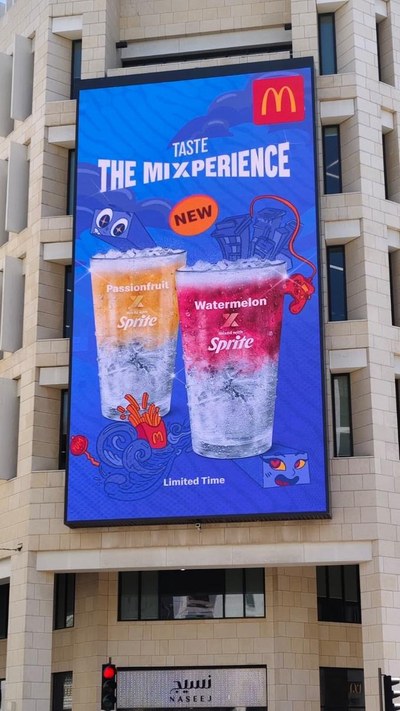

Look at the first and the third. Same campaign, same shoot, same talent. One board carries an English headline over a cold-weather palette. The other carries the Arabic line with the layout mirrored, the numerals retypeset and the logo moved to the correct corner, keyed to a 42° day. That is the Localise node doing the thing a canvas flip cannot do.
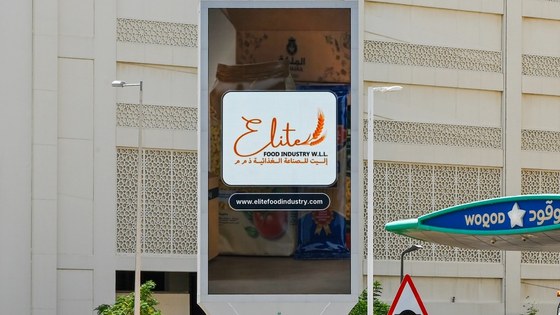
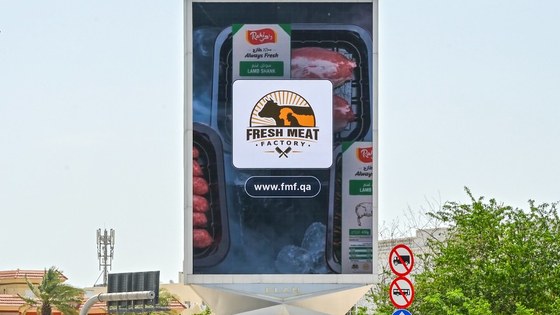
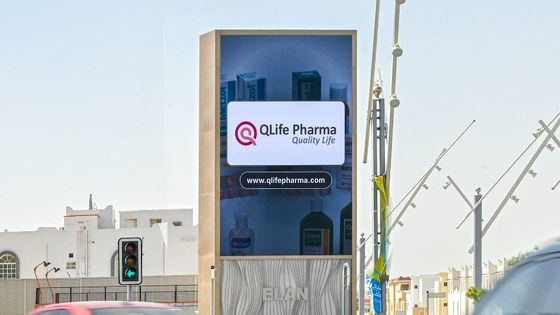

Four SME brands under the QDB programme, each with its own lockup and its own product, all produced through the same graph. One workflow, four brand contracts.
Scored on generation
Every creative the canvas produces comes back with a predicted performance score against the brand it was made for. Not a generic aesthetic rating. Scored on the things that decide whether an ad works: whether the message survives a thumb-scroll, whether the CTA is findable, whether the brand is identifiable in the first half second.
The point is triage. When a run returns 530 finished ads, somebody has to decide which eight go live. That decision used to be a meeting.
530 variants sorted by predicted performance, so the shortlist is built before the review call rather than during it.
Once the campaign runs, real results come back and get compared against what was predicted. The score gets better because your own campaigns taught it.
The review layer
Creative review is where most production time actually goes, and it almost never happens where the work lives. Feedback arrives as a screenshot in a group chat, and somebody translates it back into a change. So we put review inside the canvas.
Call anyone on your team onto a graph. They comment on a specific node, a specific layer, a specific variant. Everyone sees the change as it happens. The comment is attached to the thing it is about, which means nobody has to ask which version.
Reusable workflows
The interesting thing about a node graph is that it is a record of how the work was done. So once a multi-step ad is built and approved, save the whole graph. Next month the same campaign shape runs against a new brief, a new catalogue or a new market, and the process does not get rebuilt from memory.
This is the difference between a tool that makes one asset fast and a tool that makes a team's process repeatable. The HomesRus run above is not eight clever images. It is one saved workflow that can be pointed at next season's catalogue tomorrow.
Out the door
Approved creative pushes straight to your ad accounts, or onto the social scheduler. The calendar optimises placement timing per channel and writes the captions in the brand's voice, so the handoff from creative to distribution is not a download folder and a separate login.


 plus your connected ad accounts
Tinted days are where the scheduler expects the best return for this brand and market. Captions are generated per channel, not copy-pasted across all of them.
Results and decay
Once it is live, results come back into the platform and get analysed against the creative that produced them. What worked, what did not, and which of the 530 variants actually earned their placement.
Then the part nobody builds for. Creative fatigues. Performance on a winning ad decays on a curve that is predictable if you are watching for it and invisible if you are not. We flag decay on live campaigns and point back at the node that made the asset, so the refresh is a re-run rather than a new brief.
Brand AI visibility
A growing share of buying decisions starts inside an answer engine rather than a search results page. If a model does not know your brand, or confuses it with someone else, that is a distribution problem with no ad slot to buy.
So the platform checks it. We run your brand and category questions across the major answer engines and report whether you get cited, who gets cited instead, and which sources the engines are actually pulling from. It sits alongside the campaign reporting because it is the same question in a new channel: did anyone see us.
Brand memory
Every generation, every approved asset, every comment, every score, every published result, every decay flag. It all writes back to one brand record. That record is what makes the next campaign cheaper than the last one.
This is why the whole lifecycle has to live in one place. A scoring model that never sees real results stays generic. A localisation step that does not know which Arabic headline got approved last time relearns it every time. Split the lifecycle across five tools and the memory is the thing you lose.
Side by side
| Job | A model wrapper | ElarisLabs |
|---|---|---|
| Generate | A prompt box on a frontier endpoint | Task-shaped nodes built with creative agencies |
| Stay on brand | You paste the hex into the prompt and hope | Brand lock inherited by every downstream node |
| Scale a catalogue | Re-prompt per SKU, the offer block drifts | One locked master, offer block frozen by contract |
| Every placement | Re-prompt per ratio, logo redrawn each time | One master, every ratio, logo placed not generated |
| Arabic and RTL | Flip the canvas, break the typesetting | Mirrored layouts, retypeset, safe zones held |
| Decide what ships | A review meeting | Predicted score on every variant, pre-spend |
| Review | Screenshots in a group chat | Comments pinned to the node, live for the team |
| Repeat the process | Rebuild it from memory | Save the graph, re-run against a new brief |
| Distribute | Download folder, separate login | Push to ad accounts, scheduler, optimised calendar |
| Learn from results | Nothing comes back | Results analysed against the creative that made them |
| Keep it working | Notice the drop next quarter | Decay flagged on live campaigns, refresh from the graph |
| Get found by AI | Not a feature | Brand AI visibility tracked across answer engines |
Questions we get
ElarisLabs is a node-based creative operating system for advertising. It generates ad creative with frontier image, video and audio models behind a marketing harness, scores each creative for predicted performance, runs review inside the canvas, publishes to ad accounts and social channels, then measures results and flags creative decay. Everything writes back to a single brand memory.
No. We use the current state of the art in image, video and audio, and we swap models whenever something better ships. Model access is the commodity layer. The product is everything wrapped around it: the harness that makes output look like an ad, the brand lock, bulk generation from a locked master, the review layer, the scoring, the distribution and the measurement loop.
Bulk generate takes one approved layered master and produces thousands of finished ad variants from it. Elements marked as locked, such as the offer block, campaign dates and payment badges, stay pixel identical across the whole set, while the product scene, ratio and language vary. HomesRus used it to produce over 530 finished ads from a single signed-off concept in under four weeks.
You build creative as a graph rather than a single prompt. Each node performs one specific advertising task, such as Brand Pack for multi-ratio resizing or Localise for right-to-left markets. Because the graph is a record of the process, you can save it and re-run it against a new brief or catalogue.
A predicted performance score attached to each creative at the moment it is generated, before any media spend. It rates the things that determine whether an ad works, including brand recall speed, message clarity and CTA prominence, and it improves as real campaign results come back into the platform.
The Localise node mirrors the layout and retypesets the text rather than flipping the canvas. Logo lockups, CTA direction, numerals and safe zones are handled as part of the mirror, so an approved English master ships as a correct Arabic ad. Bilingual sets built this way are running as paid digital out-of-home in Doha.
The predictable fall in performance of a creative as an audience becomes familiar with it. ElarisLabs monitors live campaigns for decay and points back at the node that produced the asset, so the refresh is a re-run of an approved graph rather than a new brief.
A recurring check of whether answer engines such as ChatGPT, Perplexity, Claude, Gemini and Google AI Overviews cite your brand for the questions your buyers ask. It reports whether you appear, who appears instead, and which sources the engines pull from.
A brand profile, the generation, the harness that makes it look briefed, the locked master that fans out into a catalogue, the score that says what to ship, the team that signs it off, the schedule that puts it live, the results that come back, the decay flag that says refresh, and the memory that keeps all of it. In one tool, because the loop only compounds when nothing leaves the building.
That is what we are. Not the model. The rest of it.